Cellico Bio · Publication companion

Lineage Spatiotemporal Fragment Atlas for source-grounded review-region search.

Cellico Bio maps changing biological context into source-grounded protein-fragment review regions for downstream validation planning.

Byron P. Lee portrait
Founder
Byron P. Lee

M.S. Biology (Bioinformatics), Georgia State University. Former UCSF Peter Walter Lab / HHMI. Building across bioinformatics, aging biology, AI-enabled scientific workflows, and community biotech infrastructure. Founded January 14, 2026 from the CytoClock to MATER lineage.

What this companion is
A reproducible computational framework

Source-grounded protein context, directional fragment generation, scorer-lineage tracking, null controls, and claim/evidence maps — producing ranked shortlists with explicit evidence labels for downstream review.

Visual abstract

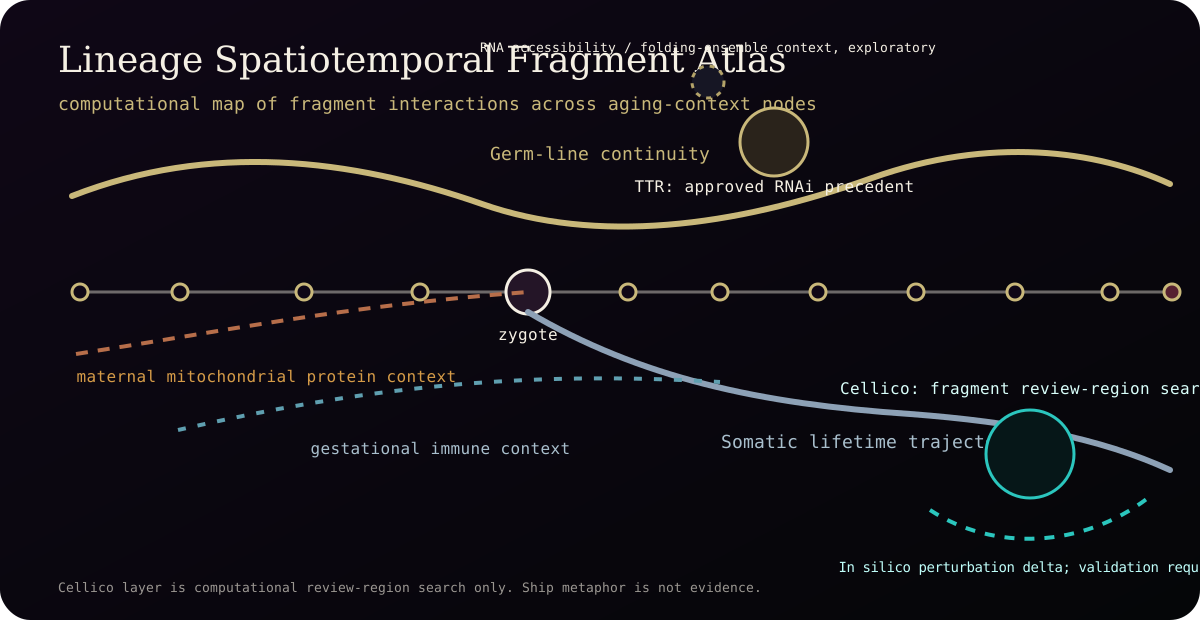
Lineage Spatiotemporal Fragment Atlas

computational map of fragment interactions across aging-context nodes

Lineage Spatiotemporal Fragment AtlasInteractive schematic showing lineage time first, then a fragment-space star chart, then a transparent Cellico Bio review-window overlay. Approved precedent nodes and Cellico Bio computational search nodes are visually distinct.Germ-line continuitySomatic lifetime trajectory / somatic restrictionmaternal mitochondrial protein contextpaternal mitochondrial cargo / clearance contextgestational immune contextCellico Bio fragment review-region search windowgrandmothermother fetal ovaryfuture child oocyteegg + spermzygoteembryobirthpubertyadultaging wavessenescencesomatic endpointTTRIAPPMAPT/tauamyloid contextaging-context nodeATTRwtRNA accessibilityIn silico perturbation delta; validation requiredCellico Bio: fragment review-region search
Approved external precedent

TTR: approved RNAi precedent

TTR is an approved RNAi target-modulation external precedent only. Cellico Bio is not claiming a care program; TTR is an anchored reference node while Cellico Bio maps fragment-level review regions for downstream validation.

refs: dailymed-onpattro-patisiran, dailymed-amvuttra-vutrisiran, fda-rna-based-medicine-patisiran

Cellico Bio computational search

Cellico Bio: fragment review-region search

Computational review region; validation required. The overlay marks where source-grounded fragment review sits across somatic and aging-context layers.

refs: No public citation required for schematic overlay

Comparator context

Aggregation-context comparators

IAPP, MAPT/tau, amyloid context, aging-context nodes, and oldest-old ATTRwt context orient the fragment-space layer. Optional prion-like context stays muted unless citation-gated.

refs: lehallier_2019, oh_2023, ding_2025_text_only, tanskanen_2008_ssa_very_aged, connors_2011_ssa_men, coles_young_2012_supercentenarian_ttr

Comparator context

Oldest-old ATTRwt context

Wild-type transthyretin amyloid is included as a somatic-endpoint context for the oldest old and for male-skewed late-life ATTRwt observations. This is context only, not a Cellico Bio TTR treatment or causality claim.

refs: tanskanen_2008_ssa_very_aged, connors_2011_ssa_men, coles_young_2012_supercentenarian_ttr

Comparator context

RNA accessibility / folding-ensemble context

Exploratory accessibility and folding-ensemble context only. The atlas does not equate RNA accessibility with a protein-state label.

refs: No public citation required for schematic overlay

Cellico Bio layer is computational review-region search only.

Static SVG exportCitation list

What this is

A computational way to read protein-fragment behavior from public sources, then label what each result can and cannot say. Review regions are short protein segments flagged for follow-up reading.

How it works

Seven steps from a public protein record to a shortlist of review regions. Each step has a captioned figure on the pipeline page.

Where the evidence stops

Every result is labelled by evidence class. The evidence map explains which statements are public framing, which are source context, and which are blocked.