01 / 08DAISY outer layer · aging hypothesis × LOMO14 SEC

DAISY: a deterministic AI layer around stochastic biology.

DAISY — Deterministic Artificial Infinite System is our proposed, extensible evidence-and-decision architecture. Vita DAISY unifies the training, testing and scientific custody of its separate computational research lanes.

Inside Vita DAISY: distinct research lanes

CELLHepG2 / Jurkat GO-proxy
KNOTPDB + Topoly / Q9PR55
TRAINProtein-group LOMO / DAISY
DYNAMICSGo-model circuit / EXP-0025
PRINTH2S dual plate submitted
PHONE → LABExecuTorch + prospective assay

Plum/gold: executed computational work · Ochre: running/submitted · Slate: proposed. Full end-to-end leave-one-module-out validation is not yet performed.

DAISY train · custody shortcut

Data + seed → model + checkpoint → frozen prediction → observation → LOMO / MSM gate → successor. Each stage retains its source and failures through addressable FCOs and independently verified Merkle breakpoints where available.

The outer layer is a design hypothesis. “Infinite” means extensible, not proven infinite computation. Biology remains stochastic and only partially observed.

Aging is the motivating objective: proteostasis and protein knots are studied, but no demonstrated causal aging intervention is established.

02 / 0801 / Evaluate a knot14 SEC

First, prove the topology. Does the model see the same knot as the experiment?

Kinetic mathematical 7₁ torus-knot illustration; this is NOT the measured Q9PR55 molecular backbone.

Experimental anchor · Q9PR55 · PDB 8JRM
7₁

Deep protein knot verified by experimental NMR/X-ray structures; Topoly recovered 52/52 recorded experimental observations.

Useful disagreement

AlphaFold recovered the 7₁ class; ESMFold classified this reference as 0₁ in the recorded comparison.

Topology identification and verification are existing research methods; the integration is the object of our study.

03 / 0802 / Train AI to recognize a knot17 SEC

A protein-group DAISY model improved held-out classification—under limitations.

EXP-0024 · 554 PDB chains · sealed 15% holdout

Seed · held-out AUROC
0.6182geometry-derived feature baseline
DAISY champion · held-out AUROC
0.9167G|C feature blocks · h16
+0.2985AUROC difference
0.106–0.48695% bootstrap CI

LOMO × breakpoints

Input groupsgeometry / sequence / termini / context
Validation5 protein-group folds
Holdout79 chains; 12 knotted
Search240 candidate combinations
Replays2 promotions reproduced
Scientific gateCHALLENGE generality

Unmatched unknotted controls; strong possible length/family confounding; no individual fold gain significant. This is classification of deposited structures, NOT an AI that learned to physically tie a protein.

04 / 08Vita DAISY train · 16–22 October16 SEC

What did Vita DAISY train—and what passed admission?

Hackathon week · 16–22 October 2026 · independent experiments, not one pooled accuracy score

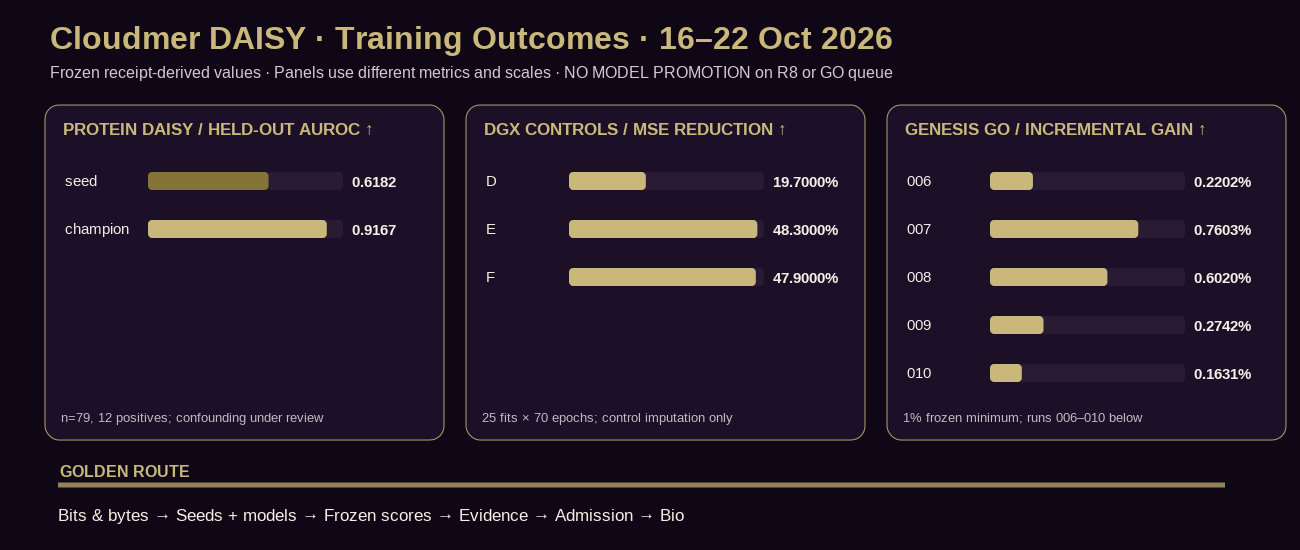
PROTEIN DAISY · OCT 22TRAINED / EVALUATED

Held-out knot recognition · AUROC ↑

Seed configuration0.6182
Selected challenger0.9167

Δ +0.2985 · 79 structures (12 positive). Generality CHALLENGED: length/family confounding.

VITA DAISY R8 · OCT 18NO PROMOTION

Validation loss ↓ · full-epoch arms

1.44318R4 parent
1.43598R8 MSM-Tiny
1.42875Admission cutoff

Numerically below the parent loss, but not below the frozen admission cutoff. Retain incumbent R4.

DGX SPARK · OCT 22REPORTED TRAINING

Control-cell masked-gene MSE reduction

Context D19.70%
Context E48.30%
Context F47.90%

25 fits × 70 epochs · 110,400 control-cell rows; not perturbation accuracy. Seeds awaiting independent source inspection.

GENESIS GO · OCT 22ALL BELOW GATE

Incremental GO gain · admission ≥ 1%

R006
0.220%
R007
0.760%
R008
0.602%
R009
0.274%
R010
0.163%

Run007 best of five on incremental gain; 5/5 scoped replays passed. Run IDs are not random seeds.

GOLDEN ROUTEBits & bytesSeeded modelsFrozen predictionsHeld-out evidenceAdmission gateBio / next test

Observed ≠ promoted · Four different metrics/scales · Exact source/seed ledger under Evidence / risks · No clinical efficacy claimed

05 / 08Actual data × original photographic references17 SEC

What did we actually train on?

Training data were not text prompts: mathematical invariants, protein coordinates, and measured gene-expression arrays entered different models.

Mathematical knot spaceEXP-0021 · Fibered-knot classifier
Jones / J+ / R / U invariantsFibered / not fibered
0.530 → 0.663; 0.681 provisional · 14–16 crossing holdout still sealed
Experimental proteinsEXP-0024 · PDB backbone classification
RCSB mmCIF Cα + sequence; G/T/C/S (selected G|C)Whole-chain Topoly knot class
0.618 → 0.917 sealed-holdout AUROC · 79 holdout chains, 12 positives; family/length confounding
Control-cell measurementsDAISY-DGX · Masked-gene prediction
110,400 reported numeric expression recordsMasked gene-expression values
D/E/F relative MSE gains reported · No drug perturbation prediction; raw seed/source check outstanding
GOLDEN ROUTEOriginal source bytes → frozen model/config → held-out evidence → honest decision → reproducible next test

Source examples and dataset counts are drawn from committed P-0029, EXP-0024 and EXP-0021 records; DGX record counts are reported in DAISY-WATCH-70. Original print assets SHA-256 bound in the figure manifest. All three datasets are separate experimental lanes.

06 / 0803 / Tie or untie a knot14 SEC

Move from recognition to mechanism: can contact circuits create or release a knot?

P-0030 · Go-model experiment

Force field → seeded trajectories → topology over time

Native 3₁

2EFV / MJ0366
→

Unfold + quench

BAOAB Langevin
→

Refold / 0₁?

Topoly closures

LOMO intervention vs matched null

Remove an eight-residue segment-pair contact group; compare refolding and knotting against size-matched random contact knockouts. Evaluate each transition with an append-only breakpoint.

Experiment preregistered and running. Earlier three-run pilot had zero successful knotting. No proven untying, rescue or mechanistic effect.

Simplified structure-based dynamics are not measured kinetic rates, and a simulated contact knockout is not a validated protease experiment.

07 / 0804 / Cut, construct, test13 SEC

When models cannot resolve the knot: perturb fragments and bring structures into the world.

One Bambu H2S build plate · operator submitted

HET-s 2RNM

Fungal prion-forming β-solenoid: amyloid architecture, not a deep knot.

Q9PR55 · 8JRM

Experimental 7₁ protein-knot structural display.

PLA-CF model + Support For PLA; deposition/mesh custody and slice settings recorded. Physical completion is NOT YET VERIFIED.

Which cut actually matters?

1

Delete / reverse

2

Reclose / measure 7₁

3

Compare to matched random edits

Sequence/fragment interventions and future protease or lab testing must be validated before any biological conclusion. No wet-lab efficacy established.

08 / 08Vita DAISY / unification15 SEC

Vita DAISY unifies Science as a Service.

DAISY — Deterministic Artificial Infinite System is the proposed outer layer governing evidence across stochastic biology. Vita DAISY unifies the scientific training and decision loop across separately tested model lanes.

EXPLORE THE PLATFORMQR code linking to https://cellico.biocellico.bioScan or tap
Science as a ServiceResearch workflow and business deliveryProduct architecture · proposed
Mechanical Scientific MethodLOMO × DAISY × frozen prediction / observationPreregistered method · partial execution
Artificial Scientific IntelligenceGenerate, evaluate, challenge and revise hypothesesProposed layered architecture · not validated AGI
Antigentic governanceAnticube actions, bounded admission, preserved failuresDecision protocol · limited validation
VITA DAISY TRAIN · CUSTODY SHORTCUTData + seed → model + checkpoint → frozen PredictionFCO → ObservationFCO → LOMO × MSM × Anticube gate → successor. Merkle breaks link verified evidence.

Merkle roots and MMRs aim to protect chain of custody and detect changes; models learn from scientific features, not hashes as predictive biological inputs. Neither custody nor replay proves biological causality. “Infinite” is an extensibility hypothesis, not a claim of infinite computation. The golden route is proposed as a unification pattern, not proven whole-framework superiority.

CONNECT / COLLABORATEQR code linking to https://www.linkedin.com/in/biobitworksLinkedInin/biobitworks · Scan or tap
“Everything in my framework can be audited from bits and bytes to business and bio.”SOURCE FCO: CONTENT-ADDRESSED / UNSIGNED · PROJECT MMR: NOT ESTABLISHED · MARK FILINGS: UNVERIFIED

© 2026 Byron P. Lee · BioBitWorks · Original authored material only. Different scientific contexts can carry different rights. More information & why we did it. Trademark filings unverified; existing and third-party rights preserved.

Source receipts, literature, novelty boundary and review risks

Hackathon training: reproducible figure exports and seed lineage

The dated training slide uses a frozen receipt-derived dataset, not simulated results. Download the typed CSV · Open the deterministic SVG figure. Regenerate both using python3 scripts/reproduce-cloudmer-training-outcomes-20261022.py. A Jupyter notebook accompanies the source repository. On-device Samsung ExecuTorch execution is NOT_VERIFIED; wet-lab knot assays are NOT_TESTED. No claim of autonomous drug discovery.

EXP-0024 uses a preregistered baseline configuration and accessions hashed into folds; a separate numeric random seed is not in the supplied excerpt. Vita R8 and DGX 25-fit PRNG seeds need their training receipts. Genesis GO identifiers R006–R010 are not random seeds. These must remain NOT_RECOVERED until confirmed.

Vita DAISY · outer-layer hypothesis and operational definition

DAISY — Deterministic Artificial Infinite System is an operator-proposed design expansion and not an independently demonstrated infinite system. The outer deterministic evidence and custody layer surrounds stochastic measurements, human decisions, training models and biological questions. Vita DAISY is the unifying training/evaluation and successor-decision workflow, not a single weight checkpoint or one merged metric. It groups mathematical knot EXP-0021, protein-topology EXP-0024, Vita Anticube R4–R8, and separately governed Cloudmer/Genesis gene-expression training without equating their objectives.

Audience shorthand — DAISY train custody: source + seed → model + checkpoint → PredictionFCO frozen → matching ObservationFCO → LOMO / MSM and Anticube admission → successor. Each transition should have scoped evidence and a Merkle checkpoint when independently constructed and verified; hashes are identity and custody aids, not predictive biological features or biological proof. Full-stack LOMO NOT_COMPUTED, aging efficacy NOT_TESTED, project MMR NOT_ESTABLISHED, signature NOT_SIGNED.

Vita DAISY framework definition and source references

Companion Cloudmer and compute lanes (distinct experiments and metrics)

GSE264667 perturbations: GO_EXP graph-proxy mean-MSE reduction vs mean null was 17.44% / 9.55% in HepG2 / Jurkat; Gate 1: FAIL. Biohub fold panel: 48 / 48 model calls, not structure accuracy. Earlier local LOCO B1 aggregate 0.65252; official VCC validation B1 overall -0.2969559, not directly comparable. Vita DAISY R8 validation loss 1.435983; R8 did not pass admission. DGX 25 × 70-epoch masked-gene controls are operator-reported and require a separately checked source receipt, not VCC perturbation efficacy.

Receipt sources: private repository biobitworks/cloudmer-knots PR #1, EXP-0024 result / P-0029 / P-0030; private FragPrint handoff bb29a70 (HET-s 2RNM, Q9PR55 8JRM); magicBLACKbox Q9PR55 research handoff; Cloudmer Oct 20 GO redteam and Oct 22 VCC handoff. Figures are source-derived or explicitly labeled mathematical illustrations.

  1. Q9PR55 experimental 7₁ topology (2023 JBC / 2024 collection): already published; not our discovery.
  2. AlphaFold knotted-protein artifact analysis: computational knot calls often need independent validation.
  3. Sequence-based knot prediction literature: prior ML knot classification exists.
  4. Proteostasis decline with aging: established aging context; no demonstrated causal role for Q9PR55.

EXP-0024: 554 chains; holdout n=79, 12 positives; AUROC seed 0.6182, champion 0.9167; delta 0.2985, 95% bootstrap interval [0.1062, 0.4857]. Negatives unbalanced for length and family, and within-fold changes do not individually meet significance. The independent dataset must be checked for grouping and selection leakage before any broad performance claim.

IP, trademark and deterministic page FCO ledger

Review rights and source-level license designations. New original code: Apache-2.0. Designated owned original research prose/figures: CC BY-NC-ND 4.0. Third-party scientific sources, photographs and AI-assisted artwork have their own rights and are not blanket relicensed.

Science as a Service / Mechanical Scientific Method / Artificial Scientific Intelligence / Antigentic are framework phrases; trademark filing and registration statuses remain UNVERIFIED. Every information occurrence may carry a different scientific and licensing context even when the source bytes are identical. Inspect the context-specific rights and provenance ledger before assuming one license applies to another context. Trademark filings are NOT VERIFIED; no pending application or registration is asserted. The source-level PageFCO is content-addressed but UNSIGNED; an authorized signing key and matching signature are NOT VERIFIED.

Open source PageFCO · Open FCO identity.

EXP-0025: preregistered P-0030, early pilot failed knotting; 8IWA calibration boundary issue; no wet-lab mechanism. Physical H2S plate submitted, finished print NOT VERIFIED. Device-side ExecuTorch and wet-lab closure NOT TESTED. Outcome-dependent branch states apply to successors only. Hashes establish byte identity, not scientific correctness. SIGNED: NOT VERIFIED. PROJECT_MMR_COMMITTED: NOT ESTABLISHED.